AI Translation Service
Overview
LEVEL INFINITE AI Translation Service (AI Translation Service) is a text translation solution built on large language models and domain-specific corpora.
The services are geared to globalization games and related pan-entertainment scenarios, support multilingual translation, and provide competencies such as glossary customized management and data statistical panels.Services can be used for in-game real-time chat, localization operations, community UGC content and instant messaging (IM, Instant Messaging) scenarios that support high-speed and low-delay cross-language text processing needs.
Application Scenarios
AI translation services are suitable for multilingual content processing and cross-language interaction scenarios, mainly including the following types.
Real-time chat translation in Project
Live Text Exchange Translation Scene for Players, including:
- Public Chat (World Chat)
- In-game chat (In-game Chat)
- Guild/Group / Squad chat (Guild / Squad Chat)
Supports translation processing for colloquial expressions, abbreviations, and informal text.
2. Community UGC content translation
Multilingual processing used for content generated by community users, including:
- Post content (Posts)
- Comment and reply content (Comments & Replies)
- Feed item content (Feed items)
Applicable for large-scale unstructured text translation.
3. Application UI and operational content localization
Used for multilingual processing of structured texts within applications or Project, including:
- UI interface copywriting
- Event Announcement and system prompts
Suitable for high-frequency updates of structured content translation.
4. Instant messaging and collaboration tool integration
Used for multilingual processing within various instant messaging and collaboration systems, including:
- Enterprise collaboration tools (such as Slack and other enterprise collaboration tools)
- Overseas customer service and support systems
Suitable for cross-language message processing and communication scenarios.
5. Project esports live translation
Used for multilingual handling of live broadcast-related content, including:
- Live chat bullet screens and chatroom message translation
- Live subtitle text translation
Suitable for cross-language audience interaction and content distribution scenarios.
Supported Capabilities
1. Multilingual text translation
The engine is specially trained for 20 languages, covering English, Japanese, Korean, Arabic, Malay, Indonesian, Thai, Turkish, Russian and other core overseas languages, and is compatible with basic translation capabilities for other languages.
The model is deeply optimized based on Project domain corpora, understands real Player expression habits, and can accurately handle colloquial short phrases, emotional expressions, abbreviations, and noisy text. It supports bidirectional translation between any languages and supports real-time and batch translation scenarios.
2. Automatic language detection
The system supports automatic language detection. Callers do not need to explicitly specify the source language parameter; the system will automatically detect the language type of the input text and complete the translation.
This detection mechanism adopts an implicit processing strategy; the system directly outputs the final translation result, and the language detection result will not be returned as an independent field.
3. Custom terminology translation
- Custom terminology library configuration: Supports configuring the terminology library based on business needs, for customized constraints and mappings on specified content during translation, ensuring consistency and controllability of translation results in multilingual environments.
- High-priority intervention mechanism: The system injects custom terminology libraries as high-priority constraints into the model during translation inference, enabling unified management and control of specific business expressions.
- Multi-dimensional isolation and invocation:
- Supports terminology isolation by Project dimension. Different business units can independently maintain their own terminology libraries.
- Supports further isolation by application scenario within the same Project, enabling differentiated terminology strategies and effectiveness control under different scenarios.
4. Context-enhanced translation
Supports introducing context information in stream-based translation scenarios to enhance semantic consistency and translation accuracy for consecutive sentences.
Typical scenario: In real-time translation such as live subtitles, explicit context information can be passed in the request to assist translation generation of the current text, improving context awareness and scenario adaptability.
5. Data analytics
Provides visual Dashboard for unified statistics and analysis of translation Service usage, performance, and language distribution.
Supports the following types of data observation:
- Usage analytics, including request counts and translated character statistics.
- Performance analytics, including average response time, P95 response time, and P99 response time.
- Trend analytics, including Service invocation trends and response time variation trends.
- Language analytics, supporting statistical distribution by target language.
Supports filtering by project, translation scenario, and time range, as well as data export, making it convenient for business users to monitor services, analyze usage, and manage operations.
6. Model configuration and multi-cloud deployment
Supports flexible configuration of translation models, output styles, and deployment regions according to business requirements to meet varying needs for latency, quality, and stability in different scenarios.
- Translation Model: Supports selection of self-developed models or third-party large models based on business scenario.
- Output style: Supports customizing translation output style according to business needs, such as more formal or more conversational.
- Multi-region deployment: Nodes cover major areas in Asia, North America, and Europe, supporting nearby access to meet performance and compliance requirements for different server regions.
Supported languages list
The AI Translation Service is currently specially optimized for twenty key languages, including:
| Category | Language Code | Language |
|---|---|---|
| Chinese | zh | Chinese (Simplified / General) |
| zh-tw | Chinese (Traditional - Taiwan) | |
| zh-hk | Chinese (Traditional - Hong Kong) | |
| East Asian Languages | ja | Japanese |
| ko | Korean | |
| Western European Languages | en | English |
| de | German | |
| fr | French | |
| es | Spanish | |
| pt | Portuguese | |
| Eastern European Languages | ru | Russian |
| pl | Polish | |
| Southeast Asian Languages | ms | Malay |
| id | Indonesian | |
| th | Thai | |
| vi | Vietnamese | |
| Middle Eastern / South Asian Languages | ar | Arabic |
| ur | Urdu | |
| Central Asian Languages | uz | Uzbek |
| South Asian Languages | hi | Hindi |
In addition to focusing on optimized languages, the system also supports general translation capabilities for more languages.
To view the complete list of supported languages, please refer to AI Translation Service Supported Languages.
Translation Workflow
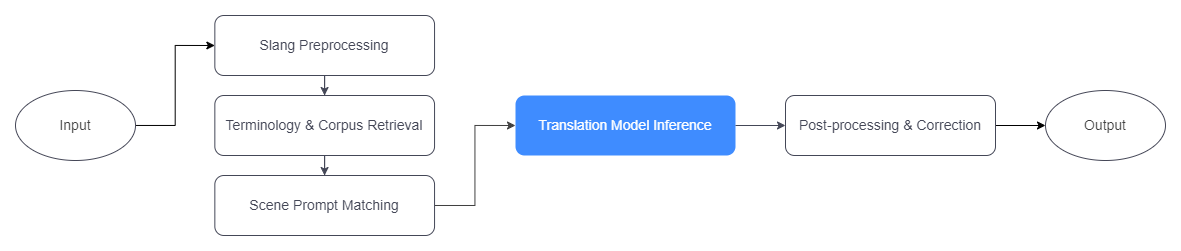
The translation engine adopts a multi-stage pipeline architecture.Translation requests undergo preprocessing before entering the model: input text is normalized to standard language, relevant terms are recalled from termbases and corpora using prefix tree, BM25, and vector retrieval, and the appropriate prompt configurations are automatically matched according to the business scenario.After translation model inference, output results are post-processed for error correction before returning the final translation result.
Integration Guidelines
The Service offers two integration methods: SDK integration and standard API integration.
For the complete integration instructions, please refer to: AI Translation Service Integration Documentation.
If you have any questions about the AI Translation Service, please see the FAQ

